How deep can horror stories go?
by Sienna Taylor
Issue 10 (March 2026)
“The Dark” by Brian Prostell is a story about a writer who is scared of the dark and slowly goes insane. Brian wrote the story in his free time as a creative project. Mrs. King said, “His story is amazing.”
The main plot of the story is about a writer who is also a murderer. He kills people in broad daylight because he is scared of the dark. As a storm draws nearer, the writer’s lights begin to cut out, causing him to slowly lose his mind. The murderer uses candlelight for a while, but the candles slowly go out, and the darkness consumes the writer’s mind and causes him to go insane.
The story uses vivid imagery and descriptive language so the reader can picture themselves in the scene. “He sat in a leather chair that creaked like a settling ship.” When the reader reads this line, they can almost hear the chair in their mind. Brian used detailed wording in his writing: “Suddenly, the desk lamp sputtered.” This creates suspense because the reader does not yet know why the lamp was flickering.
After reading Brian’s impressive story, the 8th-grade ELA teachers asked Crimson Arrow to feature his work in an article. His story showcases its advanced style and compelling plot. Michael Sexton said, “He is nice, and, all in all, treats others kindly.” This quote highlights Brian’s kind heart and his compassion for others.
Brian’s story proves that horror writing can go deeper than just scares. Through vivid imagery and suspenseful moments, he shows how fear can affect a person’s mind. With talent like this already showing in middle school, Brian’s writing may only continue to grow stronger in the future.
The Dark
By Brian Prostel
Page 1: The Silence of the Study
The hum of the humidifier was the only thing that kept him (The Protagonist) from falling into the abyss of his own thoughts. It was 3:14 AM, the hour when the world outside belonged to the dead, but inside the study, it belonged to ink. He sat in a leather chair that creaked like a settling ship. Before him sat a mechanical typewriter-a relic of a more tactile age. He didn’t use a computer for the first drafts. Digital screens were too easy to switch off, too easy to blink into blackness. The paper was permanent. Paper held the light.
On the mahogany desk sat a glass of amber scotch, untouched, and a single, high-intensity desk lamp. It cast a harsh, circular halo over the page, leaving the corners of the room in a thick velvety shroud. He didn’t like to look at the corners. He hadn’t looked at a corner in years.
He was the world’s most celebrated architect of fear. Hit novels–The Last Breath, The Basement Window, Nocturne-had sold millions. Critics called him a master of the ‘authentic chill.” They wondered how he captured the exact physiological response of a man facing his end. They called it genius. He knew it was just observation.
He rolled a fresh sheet of cream-colored bond paper into a carriage. He needed a title for Chapter 20. He typed: THE ARCHITECTURE OF COWARDICE.
Page 2: The Methodology
He leaned back, the light of the lamp reflecting in his glasses. To write a monster, he believed, one had to understand what the monster feared. Every predator had a weakness. Every killer had a closet they were afraid to open.
His current subject was a man the media had dubbed “The Hollow Man.” A killer who had terrorized the suburbs for a decade, leaving no trace but a chilling silence. The Hollow Man didn’t kill in the dark; he killed in the brightly lit kitchens, under the hum of fluorescent grocery store lights, in the midday sun of public parks.
The public thought it was bravado. They thought he was daring the world to see him.
He knew better. He tapped a rhythm on the desk with his fountain pen. Clack. Clack. Clack.
In the basement below his feet, through three inches of reinforced concrete and soundproofing foam, the “research was ongoing. He didn’t think of himself as a kidnapper. He was a curator of truth. He had found the Hollow Man six months ago, huddled in the back of a 24-hour laundromat, staring at the humming lights with a desperation that looked like prayer.
He had brought him home. Not to hurt him, but to watch him. To see what happens when a monster is stripped of his habit.
Page 3: The Manuscript (Excerpt)
The night-Stalker did not move. He sat in the white room, his eyes wide and aching from the glare of the overhead LEDs. He hadn’t blinked in minutes. To blink was to invite the darkness. Even for a microsecond. And he could no longer afford the risk.
Outside the door, he heard the muffled sound of footsteps. Then, the rhythmic tapping of a typewriter. It sounded like a clock ticking down to zero. He screamed, but the walls swallowed the sound, digesting his terror and leaving nothing behind but the hum of the air vents.
“Please,” he whispered to the camera in the corner. “Just leave the light on, I’ll tell you everything. I’ll tell you where the bodies are. I’ll tell you why I did it. Just… don’t turn it off.”
But the man on the other side of the wall wasn’t interested in the bodies. He was interested in the trembling. He was interested in the way the Stalkers’ pupils dilated until they swallowed the iris. He wanted to document the precise moment when a man’s soul breaks under the weight of an empty room.
Elias stopped typing. He felt a bead of sweat roll down his temple. The “Stalker” in his book was becoming too real,or perhaps, the man in his basement was becoming too much of a character. The lines were blurring,like ink dropped in a glass of water.
Page 4: The Flickering
Suddenly, the desk lamp sputtered.
He froze. His heart hammered against his ribs-a frantic, uneven beat. The high-intensity bulb, rated for ten thousand hours, gave a sickly yellow pop. The halo of light on his desk wavered, shrinking and expanding like a dying lung
“No,” he whispered.
He looked toward the door. The hallway light was still on, visible through the crack under the study door, but then, that too began to fail. A low-frequency hum vibrated through the floorboards. The grid was failing. A summer storm he hadn’t noticed was finally making its presence known with a distant, low growl of thunder.
The house, his sanctuary of controlled illumination, was about to betray him. And downstairs, in the dark, the man who knew the most about killing was about to realize that his prison door was electronic.
If the power went out, the magnets would release
He reached for the heavy brass letter opener on his desk. He wasn’t afraid of the killer. He was afraid of what the killer would do once he was submerged in the one thing they both feared.
The lamp gave one final, desperate flash and died.
The darkness wasn’t just the absence of light. It felt heavy. It felt like it was leaning against his chest, waiting for his eyes to close.
Page 5: The Unseen Presence
The silence that followed the power failure was absolute. He sat frozen in his chair, the heavy brass letter opener slick with the sweat of his palm. He didn’t breathe. He listened for the click of the basement’s magnetic lock-the sound that would mean the “research subject” was no longer contained.
Clack.
The sound echoed up the floorboards, vibrating through the legs of his desk. Somewhere below, the door had swung open.
He stood, his hand trailing along the cold mahogany of his desk to find the wall. He navigated the study by memory, but the darkness felt different now. It didn’t feel like an empty room; it felt crowded. It felt as though the shadows were leaning in, exhaling a cold, metallic breath against his neck.
“I know you’re out there,” He whispered into the void.
There was no response, only a soft, dragging sound from the hallway, Sshh-clink. Sshhh-clink. It sounded like a man walking with a heavy chain, or perhaps a man too weak to lift his feet.
He reached the door to the hallway. He could see nothing. The windows were shuttered against the storm, and the mood was buried under a thick shroud of clouds. He felt a sudden, frantic urge to break the blackness. But he was paralysed. He realized that in his quest to document fear, he had invited a predator that didn’t need eyes to find him.
The dragging sound stopped right in front of him.
He held his breath until his lungs burned. He waited for the strikes, for the hands, for the end. But there was only a low, rhythmic whimpering. The sound of a monster that had finally been broken by the very thing it was used to hide in.
Page 6: The Final Sentence
He retreated, stumbling back toward his desk. Hisshins barked against the wood, but he didn’t cry out. He fell for the typewriter, his fingers ghosting over the cold metal keys. He didn’t need to see. The keys were the only map he had left.
He began to type. The clack-clack-clack of the hammers was the only light in the room-a rhythmic, mechanical heartbeat.
He typed the ending he had planned for months. The ending that would cement his legacy. The truth he had finally extracted from the shadows:
“I Find the Killer, And He’s Afraid of the Dark”
He ripped the paper from the carriage. The sound was like a bone snapping.
He didn’t look back at the door. He didn’t check to see if the dragging sound had started again. He simply sat there, staring into the absolute blackness of his own office. He realized that the book was finished, the story was told, and the killer was finally caught, not by the law, and not by him, but by the absence of everything.
He closed his eyes, but it didn’t matter. The dark was already inside.
Please don’t close the book.
I’m scared of the Dark
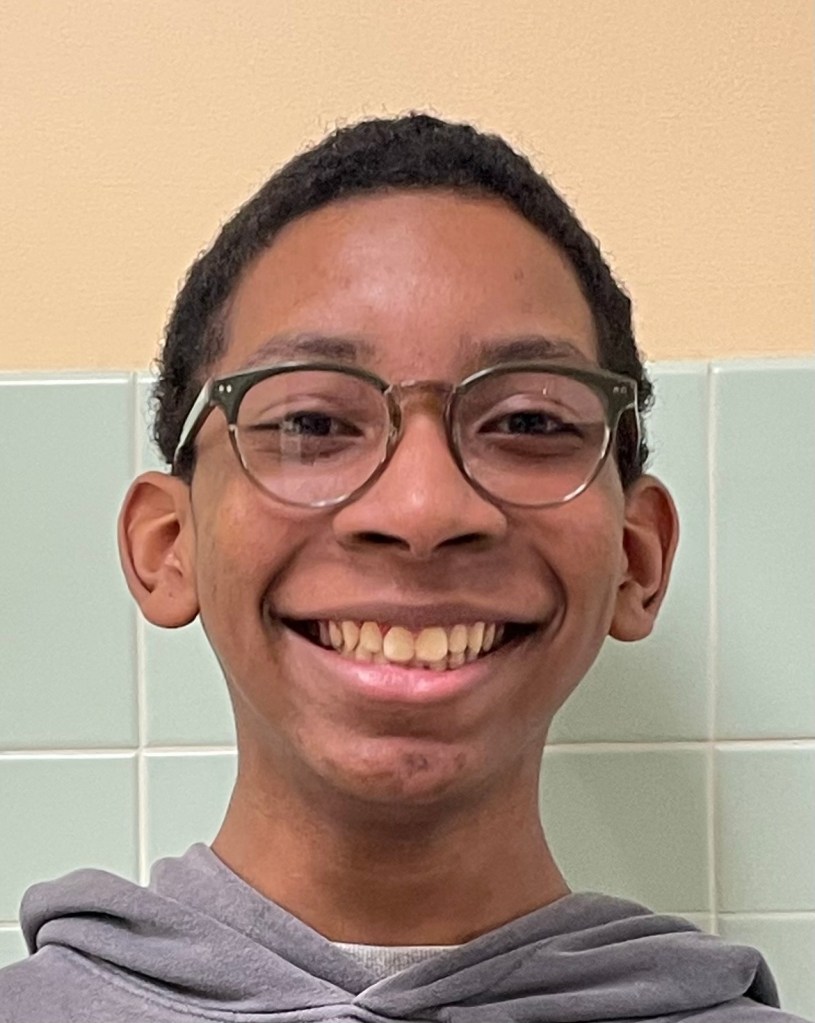
Picture of Brian Prostel taken by Sienna Taylor
Brooklyn Braun does it all
By Dean Hart
Issue 1 (September 2025)

Picture of Brooklyn Braun. Photo taken by Elaina Pitcock
Dean interviewed Brooklyn Braun for the September Student Spotlight. Dean asked her several questions about her likes and dislikes. Brooklyn is very interesting and does lots of things outside of school. Here is a little more about Brooklyn.
Here are some things that Brooklyn likes to do in school, school events included. Brooklyn is in Mrs. Matko’s class. Mrs. Matko teaches Spanish, and Brooklyn wants to learn Spanish. She is interested in learning the language because it is one of the most used languages in the world.
Theatre is a hobby Brooklyn likes. She has been in several school shows, but also some out of school. Brooklyn has been in Little Women, Newsies, and The Christmas Carol, and a few more. Track is another school-based event she is involved in, but it is after school. She shows up every day, except Fridays, and practices.
Out of school activities include softball, figure skating, and more theater. Brooklyn plays softball at the baseball fields on Gabriel Ave. The team name is McDonalds. She also does figure skating at the S&T Area. Last year, she did theater at the IUP Footlight camp. Brooklyn also used to do Beauty Pageants.
Dean asked Brooklyn many questions about different subjects. One was if she could have any superpower, what would it be and why? Brooklyn responded, “Teleportation, because I could teleport anywhere I wanted.” Dean also asked about her favorite book. She said, “The summer I Turned Pretty.” Next, Dean asked if she could go anywhere, where would she go? Brooklyn told him that she would go to Italy because she liked Italian food. Lastly, Dean asked when she grew up, what she would want to be. Brooklyn said she wants to be a doctor because they make a lot of money.
 jhcrimsonarrow.com